Korean Driver’s License Test Procedure and Driving Academy Guide
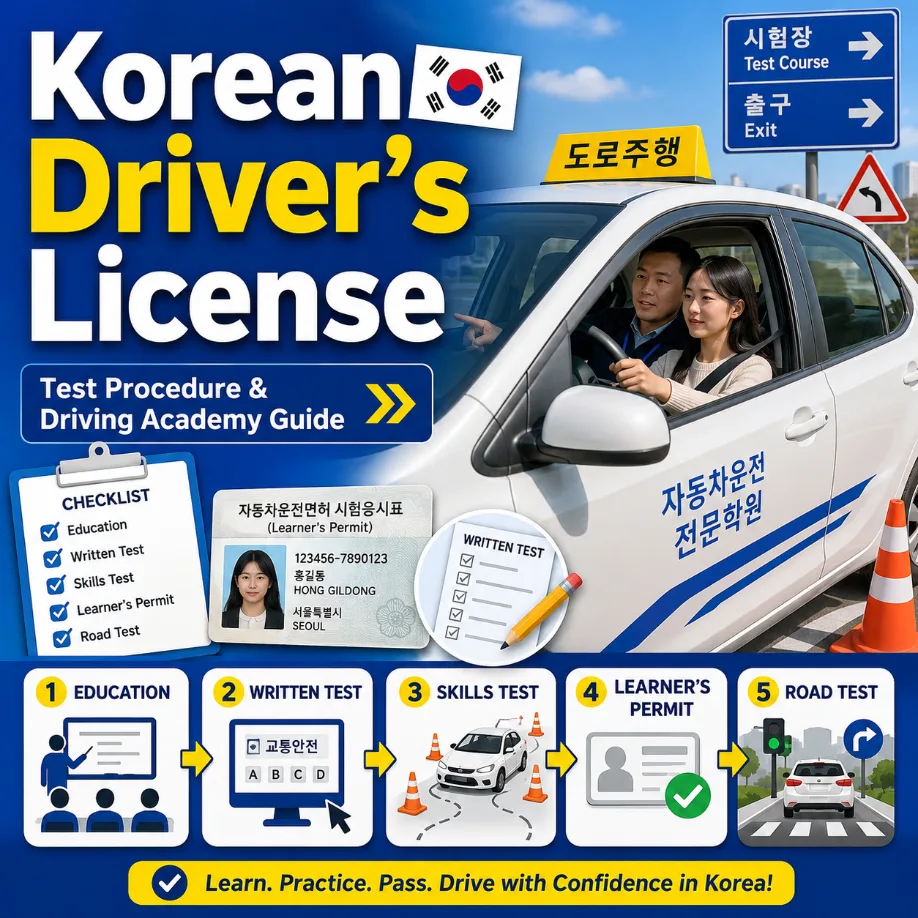
Getting a driver’s license in Korea may seem complicated at first because applicants must complete several stages before receiving the license. The standard process includes traffic safety education, a physical examination, a written test, a driving skills test, issuance of a learner’s permit, and an on-road driving test.

Applicants may complete each stage directly at a driver’s license examination center or enroll in a certified driving academy. Both methods require applicants to meet the same legal and physical requirements, but the places where education and testing are provided may differ.
Driver’s License Application Steps
Standard Test Order
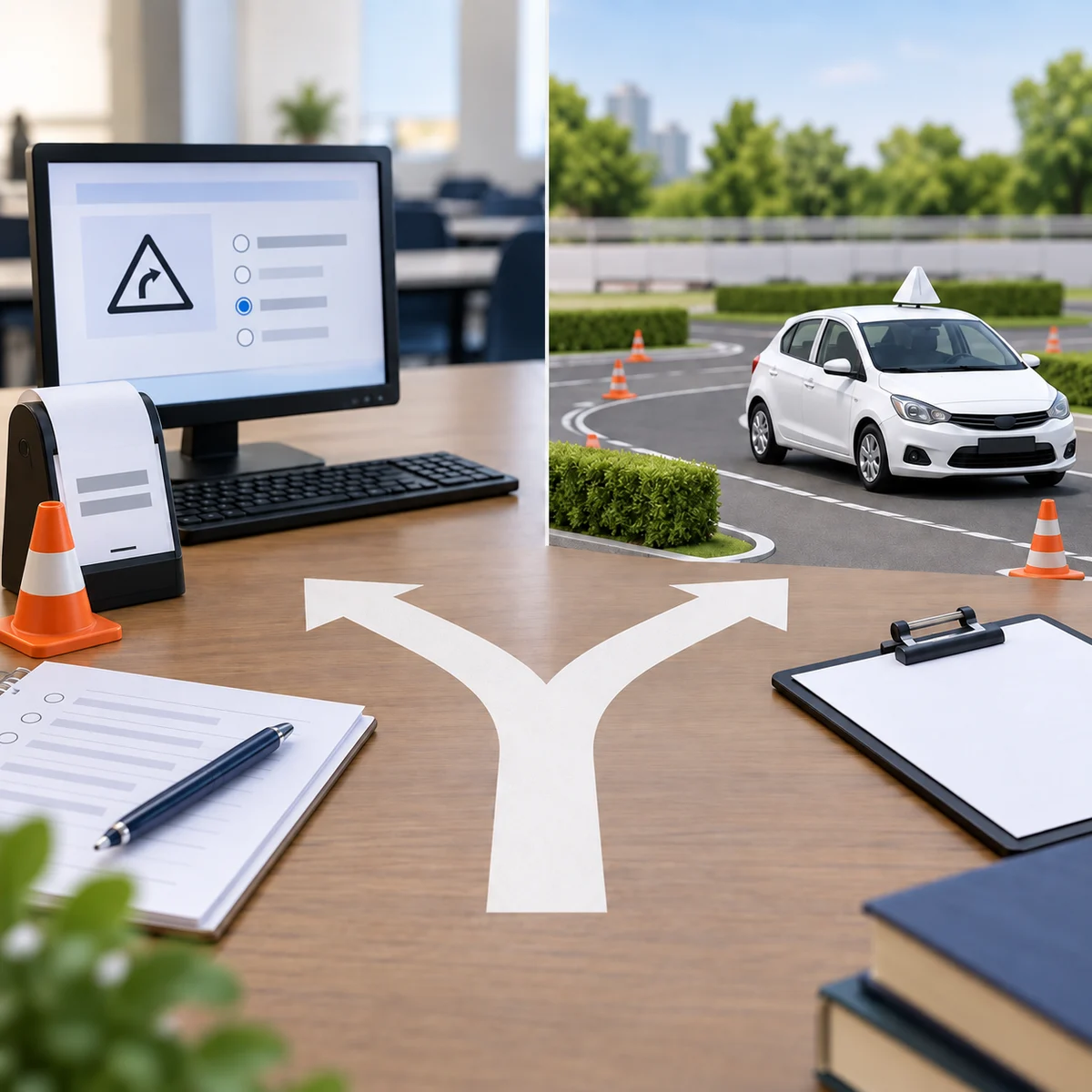
Applicants who take the tests directly at a driver’s license examination center normally begin with traffic safety education. They must then complete a physical examination before taking the written test. After passing the written test, they may take the driving skills test. Applicants who pass the driving skills test receive a learner’s permit, which allows them to practice driving on public roads. The final stage is the on-road driving test. A driver’s license can be issued after the applicant passes this test.
Examination Center and Driving Academy Differences
Applicants using a driver’s license examination center must arrange and apply for each test individually. They may also need to find a suitable vehicle and a qualified accompanying driver for on-road practice.
A certified driving academy provides classroom education, driving skills training, and on-road driving lessons according to the academy’s schedule. Some certified academies are authorized to conduct their own driving skills and on-road driving tests. Tuition is generally higher than applying directly at an examination center, but applicants can use academy vehicles and receive instruction from qualified driving instructors.
Traffic Safety Education Requirements
Eligible Applicants and Education Time
Anyone applying for a driver’s license for the first time must complete one hour of traffic safety education before taking the written test. The education is generally provided through audiovisual lessons at a driver’s license examination center. Applicants who have not completed the required education cannot take the written test.
Before visiting an examination center, applicants should check whether advance reservations are required and confirm the available education times.
Main Education Topics
Traffic safety education covers the basic manners and responsibilities expected of drivers, traffic laws, safe driving practices, accident prevention, and the correct response after a traffic accident.
The lesson also covers methods for protecting children, elderly people, people with disabilities, and other vulnerable road users. Applicants learn how to yield to emergency vehicles and how to drive in ways that reduce fuel use and vehicle emissions.
Education Exemption Cases
A person applying for a new license after a previous license cancellation may not need to complete the standard traffic safety education if that person has already completed mandatory special traffic safety education.
Applicants who complete the required classroom education at a certified driving academy are also exempt from taking the separate one-hour traffic safety lesson at an examination center.
Physical Examination Requirements
Examination Locations
Driver’s license applicants must undergo a physical examination to confirm that they are medically capable of operating a vehicle. The examination may be completed at a physical examination office inside a driver’s license examination center or at a designated hospital.
Not every examination center has an on-site physical examination office. Applicants should confirm whether the service is available before visiting.
Class 1 License Vision Standard
For a Class 1 driver’s license, the applicant’s combined eyesight must be at least 0.8, and the eyesight in each eye must be at least 0.5. Corrected vision with glasses or contact lenses is accepted.
A person who cannot see through one eye may still apply for a Class 1 ordinary license if the eyesight in the other eye is at least 0.8. The applicant must also meet additional visual field requirements, including horizontal and vertical field standards.
Class 2 License Vision Standard
For a Class 2 driver’s license, the applicant’s combined eyesight must be at least 0.5. A person who cannot see through one eye must have eyesight of at least 0.6 in the other eye.
Applicants who do not meet the standard without corrective lenses may be examined while wearing glasses or contact lenses.
Color Recognition and Hearing Standards
Applicants must be able to distinguish red, green, and yellow. This requirement ensures that drivers can correctly identify traffic signals and safety signs.
The general hearing standard requires applicants to hear a sound of 55 decibels. Applicants using hearing aids must be able to hear a sound of 40 decibels.
Physical Disability Assessment
Applicants must be able to operate essential vehicle controls, including the steering wheel, brake, and accelerator. A physical or mental condition that prevents normal vehicle operation may require an additional assessment.
A person with a disability may still qualify for a driver’s license when normal driving is possible with approved assistive equipment or a specially modified vehicle. A medical opinion, driving ability assessment, or evaluation using specialized equipment may be required.
Alternative Medical Documents
A health examination report issued within two years of the driver’s license application may be accepted instead of a new physical examination. Other accepted documents may include a medical examination certificate, a doctor’s diagnosis, or the results of a military service physical examination.
The documents accepted can vary depending on the license category and the applicant’s medical condition. A person who cannot see through one eye and wishes to apply for a Class 1 ordinary license may be required to submit a diagnosis issued by a doctor.
Written Test Application Requirements
Application Form and Documents
Applicants must complete a driver’s license examination application form and present valid identification. They must also prepare three recent color photographs.
The photographs must have been taken within six months of the application date. The applicant must not be wearing a hat, and the photograph must show the upper body against a plain background. Each photograph must measure 3.5 centimeters in width and 4.5 centimeters in height.
Medical Declaration Forms
Applicants for a Class 1 large vehicle license or a special vehicle license must submit a medical history declaration.
Applicants for a Class 1 ordinary license or a Class 2 license must complete a disease and physical condition declaration. Any medical conditions or medications that may affect driving should be reported accurately. Providing false information may lead to disadvantages even after the license has been issued.
Application Validity Period
The driver’s license examination application is generally valid for one year from the date of the first written test.
When a Class 1 ordinary or Class 2 ordinary learner’s permit is issued, the remaining validity period follows the validity period of the learner’s permit. Applicants should complete the required tests within the permitted period. Otherwise, they may need to repeat previously completed stages.
Written Test Subjects
The written test mainly covers Korean traffic laws, traffic safety rules, accident handling requirements, vehicle registration, vehicle inspection, and safe driving knowledge.
Questions may also cover basic vehicle inspections, how to identify minor mechanical problems, and fuel-efficient driving methods. Rather than memorizing answers only, applicants should understand traffic signs, right-of-way rules, pedestrian protection duties, and accident prevention practices.
Written Test Passing Scores
Applicants for a Class 1 license must receive at least 70 points. Applicants for a Class 2 license or a motorized bicycle license must receive at least 60 points.
Results are usually available on the day of the examination. Applicants who pass may proceed to the driving skills test.
Written Test Validity Period
A passing written test result is valid for one year from the date of passing. During this period, the applicant does not need to take the written test again.
Applicants who fail to complete the driving skills test and on-road driving test within the permitted period may need to take the written test again.
Driving Skills Test Information
Skills Test Application
Applicants may apply for the driving skills test after passing the written test. Those who fail the skills test must submit another application before taking it again.
The test is conducted at the driving skills testing area of the examination center on the scheduled date and time.
Skills Test Evaluation Items
The driving skills test examines whether an applicant can correctly operate vehicle controls and follow traffic rules. Depending on the license category, the test may include starting and stopping, using turn signals, changing gears, maintaining the correct lane, passing intersections, and responding to sudden hazards.
Test items and scoring standards vary by license category. Applicants should review the requirements for the license they plan to obtain.
Skills Test Results
The result is normally provided immediately after the applicant completes the test. Failure to attend at the scheduled time may be treated as a failed attempt.
An applicant who fails the driving skills test must wait at least three days from the date of failure before taking the test again.
Learner’s Permit Requirements
Learner’s Permit Validity
Applicants who pass the driving skills test may receive a learner’s permit for on-road driving practice. The learner’s permit is valid for one year from the date of issuance.
The permit automatically becomes invalid when the holder obtains a Class 1 ordinary or Class 2 ordinary driver’s license, even if the original one-year validity period has not expired.
Qualified Accompanying Driver
A learner’s permit holder practicing on public roads must be accompanied by a person who has held the appropriate driver’s license for at least two years.
The accompanying person must hold a license that permits the operation of the vehicle being used. A person whose driver’s license is currently suspended cannot act as the supervising driver.
Practice Driving Sign
A vehicle used for on-road practice must display a practice driving sign so that other road users can easily recognize that a learner is driving.
The sign should meet the required size and placement standards. It must be visible from both the front and rear of the vehicle.
Prohibited Driving Activities
A learner’s permit may only be used for driving practice. It cannot be used to transport passengers or cargo for payment or to operate a commercial vehicle for business purposes.
A learner’s permit may be canceled when the holder causes a traffic accident intentionally or through negligence, violates traffic laws, or fails to comply with an official order or administrative decision.
On-Road Driving Test Information
Eligibility and Retest Period
Applicants may take the on-road driving test after receiving a learner’s permit.
A person who fails the on-road driving test must wait until three days have passed from the date of failure before applying for another attempt. A new test date and time must be reserved.
On-Road Test Evaluation
The on-road driving test evaluates whether the applicant can safely operate a vehicle on public roads while following traffic laws.
Major evaluation items may include lane changes, intersection entry, traffic signal compliance, turn signal use, speed limit compliance, pedestrian protection, safe following distance, and correct responses to surrounding traffic conditions. Memorizing the test course alone is not enough. Applicants must be able to make safe decisions based on actual road conditions.
On-Road Test Scoring
The examiner riding in the vehicle may enter the score directly into an electronic scoring device. Some items may also be recorded automatically.
When electronic scoring is not possible because of equipment failure or another technical problem, the examiner may record the score manually on an on-road driving test sheet. The result is normally announced immediately after the test.
Certified Driving Academy Information
Certified Academy Requirements
A certified driving academy is different from a general driving school. To receive official certification, an academy must have approved training facilities, practice grounds, training vehicles, qualified instructors, and personnel authorized to conduct driving tests.
Applicants should confirm that the academy has been officially designated by the relevant regional police authority, especially when they want to take the driving tests at the academy.
Unregistered Driving Lessons
A person or business that has not completed the required registration cannot legally provide paid driving lessons or operate paid driving practice facilities.
Applicants considering private driving lessons should confirm that the provider is properly registered. Unregistered instruction may lead to insurance, accident liability, and consumer protection problems.
Academy Education Courses
Applicants enrolled in a certified driving academy generally complete classroom education, driving skills lessons, and on-road driving lessons.
Those who complete the required classroom education at the academy do not need to take the separate traffic safety education provided at an examination center. After completing the required classroom and driving skills lessons, applicants may take a driving skills test at the academy when it is authorized to conduct testing.
In-House Test Availability
Not every driving school is permitted to conduct its own tests. Only certified driving academies officially authorized by the regional police authority may conduct in-house driving skills tests and on-road driving tests.
Before registering, applicants should ask whether the academy conducts both education and testing or whether students must take the official tests at a separate driver’s license examination center.
Driving Academy Tuition Rules
Tuition Fee Display
Certified driving academies must display their tuition rates in a location that is easy for students to see. They are not permitted to charge more than the displayed amount.
Before signing a contract, students should confirm whether insurance fees, test fees, retest fees, additional lesson charges, and administrative expenses are included in the advertised tuition.
Refund Before Education Begins
A student who cancels the contract before education begins is generally entitled to a full refund of the tuition paid.
Even when a contract contains a separate cancellation charge, students should check whether the condition complies with the applicable consumer protection requirements.
Refund Caused by Academy Issues
When education cannot continue because the academy has been suspended, closed, relocated, or had its registration or certification canceled, the student may receive a refund for the education hours that were not provided.
The refund may be calculated by subtracting the cost of completed education hours from the total tuition already paid.
Refund Caused by Illness or Injury
A student who cannot continue education because of illness, injury, legal detention, or another unavoidable reason may receive a refund based on the proportion of remaining education hours.
This standard generally applies when the student has not yet obtained a driver’s license. The academy may request medical documents or other evidence explaining why the student cannot continue.
Refund Caused by Personal Cancellation
When a student stops attending because of personal circumstances or voluntarily gives up the course, the entire remaining tuition is not always refunded.
The amount may be calculated by subtracting the cost of completed lessons from the tuition already paid and refunding 50 percent of the remaining balance.
Early License Acquisition
When a student obtains a driver’s license before completing all scheduled education, the academy may not be required to refund the cost of the remaining lessons.
Students who may complete the license process early should check the academy’s contract terms regarding unused education hours before registering.
Driving Lesson Cancellation Rules
Academy Responsibility
When an academy fails to provide a scheduled lesson without discussing the matter with the student in advance, it may be required to compensate the student for the tuition corresponding to the missed education time.
When the academy discusses the schedule change with the student in advance but still fails to provide the lesson, compensation based on a portion of the missed lesson fee may apply.
Student Responsibility
Students who notify the academy of a cancellation at least 48 hours before the scheduled lesson are generally not responsible for compensation.
The amount charged may increase as the scheduled lesson time approaches. Students who cancel after the scheduled time or fail to attend without notice may be required to pay up to 50 percent of the applicable lesson fee.
Cancellation Notice Periods
When a student cancels between 48 and 24 hours before the lesson, the charge may equal 10 percent of the applicable lesson fee.
When a student cancels between 24 and 12 hours before the lesson, the charge may equal 20 percent. When cancellation occurs less than 12 hours before the lesson but before the lesson begins, the charge may equal 30 percent.
A student who provides notice after the scheduled lesson time or fails to attend without notice may be charged 50 percent of the lesson fee. Because cancellation procedures differ by academy, students should confirm whether a telephone call, text message, or online request is required.
Final Preparation Checklist
Required Document Check
Applicants should bring valid identification, recent photographs, the examination application form, and any required medical documents when visiting an examination center.
Each test may require a separate application or reservation. Applicants should confirm the test date, test time, and application status before visiting. A lost or damaged examination card may need to be reissued before the test.
Validity Period Check
Applicants should regularly check the expiration dates of their written test result, examination application, and learner’s permit.
Allowing the permitted period to expire may require the applicant to repeat an earlier test. After passing the driving skills test, it is advisable to begin on-road practice and schedule the final test without unnecessary delay.
Academy Contract Check
Before enrolling in a certified driving academy, students should review the total education hours, tuition, test fees, additional lesson charges, retest fees, cancellation charges, and refund conditions.
Any promises made verbally should also appear in the written contract or official information provided by the academy.
License Application Method
Applying directly through a driver’s license examination center can reduce expenses, but applicants must personally arrange test applications, driving practice, and a suitable practice vehicle.
A certified driving academy provides training vehicles and professional instruction, making it more convenient for beginners. However, academy tuition adds to the total cost. Applicants should choose a method based on their driving experience, access to a practice vehicle, available preparation time, and budget.
Conclusion
Obtaining a driver’s license in Korea requires applicants to complete traffic safety education, a physical examination, a written test, a driving skills test, learner’s permit practice, and an on-road driving test. Applicants may complete these steps independently through a driver’s license examination center or enroll in a certified driving academy for professional instruction and access to training vehicles. Direct testing may reduce expenses, while academy enrollment can be more convenient for beginners who need guided lessons. Before applying, it is important to check document requirements, test validity periods, learner’s permit rules, academy fees, cancellation policies, and refund conditions. Careful preparation at each stage can help applicants avoid repeated tests, unexpected charges, and delays in receiving their license.
Choosing your written-test date first?Once you understand the full licensing process, choose an actual operating date. The Saturday written-test schedule, booking, and walk-in guide explains the center-by-center checks and same-day education precautions.
FAQ
Do I have to complete traffic safety education before taking the written test?
First-time applicants must generally complete one hour of traffic safety education before taking the written test. Applicants who complete the required classroom education at a certified driving academy may be exempt from the separate traffic safety lesson.
How long is a passing written test result valid?
A passing written test result is generally valid for one year from the date of passing. Applicants should complete the remaining tests within this period to avoid having to take the written test again.
What is the passing score for the written test?
Applicants for a Class 1 driver’s license must score at least 70 points. Applicants for a Class 2 license or a motorized bicycle license must score at least 60 points.
How soon can I retake a failed driving test?
Applicants who fail the driving skills test must wait at least three days before taking it again. The same waiting period generally applies to applicants who fail the on-road driving test.
How long is a learner’s permit valid?
A learner’s permit is valid for one year from the date of issuance. It becomes invalid earlier when the holder obtains a Class 1 ordinary or Class 2 ordinary driver’s license.
Can I practice driving alone with a learner’s permit?
No. A learner’s permit holder must be accompanied by a person who has held the appropriate driver’s license for at least two years. The accompanying driver’s license must not be suspended.
Is a certified driving academy required to obtain a Korean driver’s license?
No. Applicants may complete the tests directly at a driver’s license examination center without attending an academy. A certified driving academy is an optional choice for applicants who want professional instruction, training vehicles, and academy-based testing where available.
Can every driving school conduct its own license tests?
No. Only certified driving academies officially authorized by the relevant regional police authority may conduct in-house driving skills or on-road driving tests. Applicants should confirm the academy’s certification before registering.
Can I receive a refund after driving lessons have started?
A partial refund may be available depending on the reason for cancellation and the number of education hours already completed. Refund amounts differ when cancellation is caused by the academy, illness or injury, or the student’s personal decision.
What should I check before registering with a driving academy?
Applicants should check the total tuition, insurance charges, test fees, retest fees, additional lesson costs, cancellation charges, refund terms, education hours, and whether the academy is authorized to conduct its own tests.