Korean License Overview
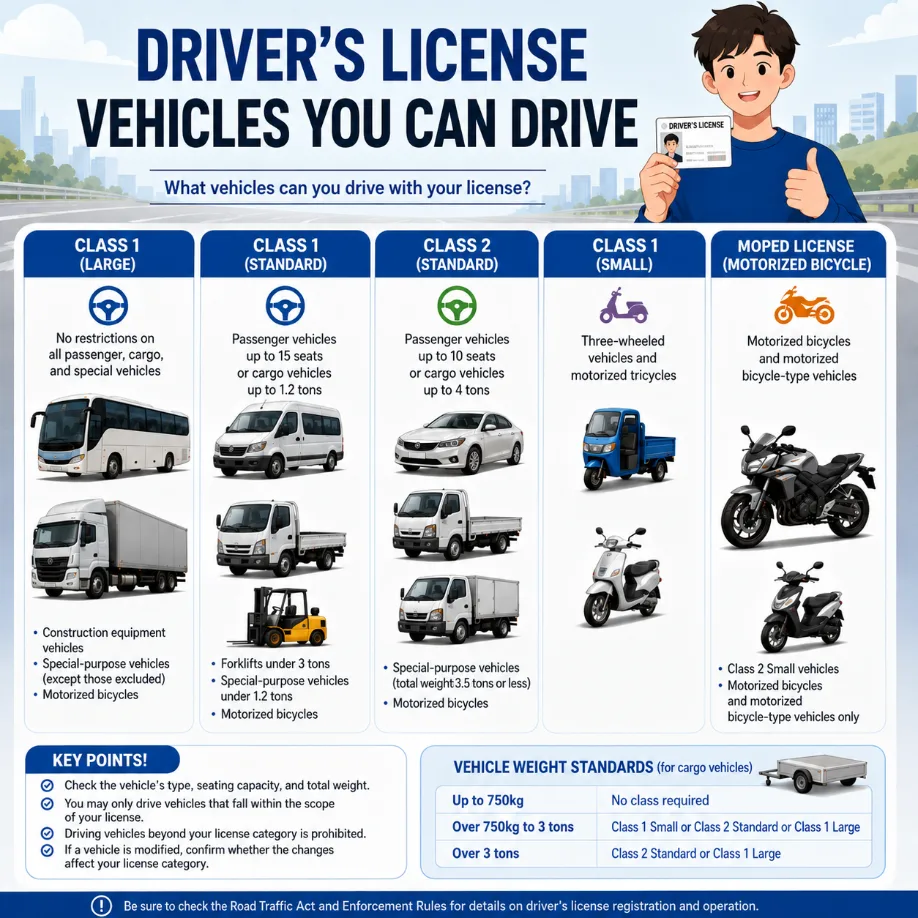
In South Korea, the vehicles you are legally permitted to drive depend on your driver’s license category and the official information shown on the vehicle registration certificate. A vehicle’s appearance, model name, or commonly used description is not enough to determine whether your license covers it. Two vehicles that look similar may be registered as different types, such as a passenger car, passenger van, cargo vehicle, or special-purpose vehicle. Before driving an unfamiliar vehicle in Korea, you should check its registered vehicle type, passenger capacity, cargo capacity, gross vehicle weight, and modification history.
Vehicle Registration Priority
The vehicle registration certificate is the most reliable document for checking license eligibility in South Korea. Camper vans, converted vehicles, work trucks, and recreational vehicles may look similar from the outside while belonging to different legal categories. The license requirement is determined by the registered category rather than the name commonly used by the owner, dealer, or manufacturer.
Passenger Capacity Rules
Passenger vans are classified according to the passenger capacity recorded on the registration certificate. The number of people actually inside the vehicle does not change the license requirement. An 11-seat van remains an 11-seat vehicle even when only the driver is riding in it. A Class 2 Ordinary License permits passenger vans with a registered capacity of up to 10 people, while an 11-seat vehicle requires at least a Class 1 Ordinary License.
Cargo Capacity Rules
Cargo vehicles are checked according to their registered cargo capacity rather than their empty weight or total operating weight. A Class 2 Ordinary License generally permits cargo vehicles with a cargo capacity of up to 4 metric tons. A Class 1 Ordinary License permits cargo vehicles with a registered cargo capacity below 12 metric tons. Even when a vehicle is commonly called a 1-ton truck, 3.5-ton truck, or 5-ton truck, the cargo capacity written on the registration certificate should be checked.
Special Vehicle Weight
General special-purpose vehicles are checked according to their registered gross vehicle weight. A Class 2 Ordinary License permits general special-purpose vehicles weighing up to 3.5 metric tons, while a Class 1 Ordinary License permits general special-purpose vehicles weighing below 10 metric tons. Towing vehicles and recovery vehicles may require a separate special license even when their weight falls within these limits.
Inclusive Limit Wording
The wording used for Korean license limits is important. A rule stating “up to 4 tons” includes a vehicle registered at exactly 4 tons. A rule stating “below 12 tons” does not include a vehicle registered at exactly 12 tons. The same principle applies to passenger capacity. A limit of up to 10 passengers includes a 10-seat vehicle but excludes an 11-seat vehicle.
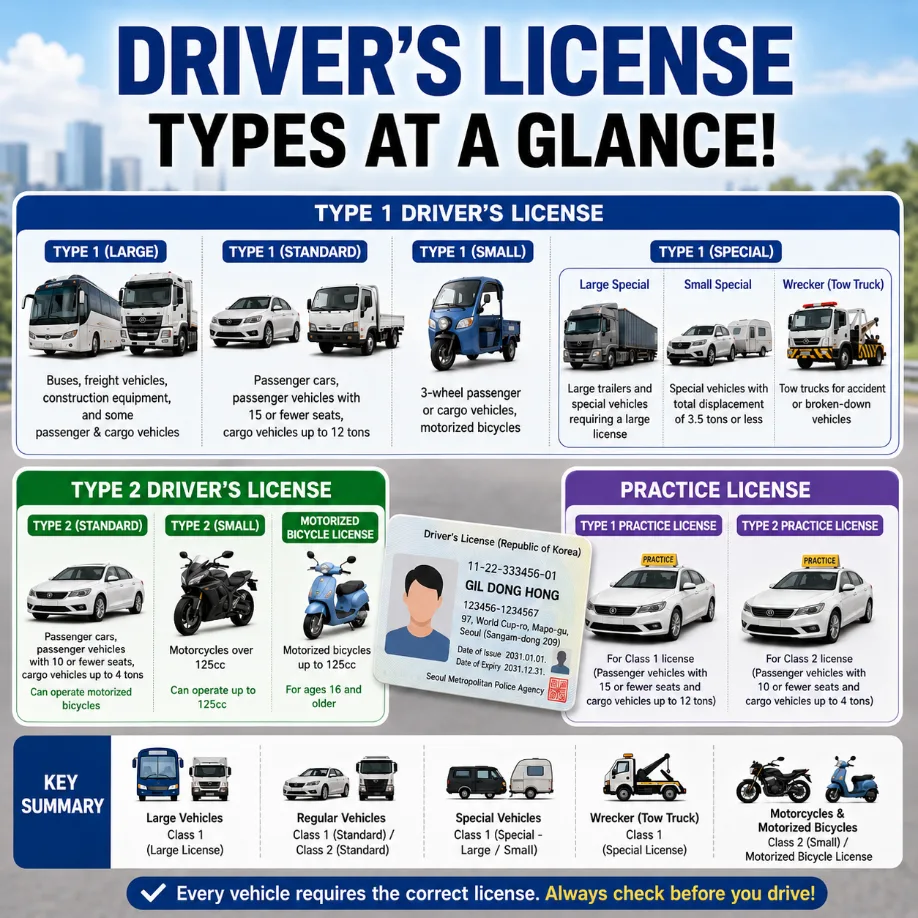
Class 1 Large License
Large License Coverage
A Class 1 Large License permits the operation of passenger cars, passenger vans, buses, and cargo vehicles without the passenger-capacity and cargo-capacity limits applied to ordinary licenses. It can cover vehicles ranging from compact passenger cars to full-size buses and heavy cargo trucks. Commercial driving may still require an additional professional qualification, such as a bus driver qualification or cargo transportation qualification.
Passenger Car Coverage
A Class 1 Large License permits ordinary passenger cars, including compact cars, sedans, sport utility vehicles, and large private passenger vehicles. Vehicle size and engine displacement are not the main factors when the vehicle is officially registered as a passenger car.
Bus And Van Coverage
A Class 1 Large License permits passenger vans and buses without a general seating-capacity limit. It can be used for small vans, minibuses, vehicles with 16 or more seats, and full-size buses. A passenger vehicle registered for 16 or more people cannot be driven with a Class 1 Ordinary License.
Heavy Truck Coverage
A Class 1 Large License permits cargo vehicles without the cargo-capacity limit applied to ordinary licenses. It covers standard light trucks as well as heavy cargo vehicles registered for 12 tons or more. Separate qualifications may be needed when the vehicle transports hazardous materials or is operated for commercial freight services.
Construction Vehicle Coverage
A Class 1 Large License covers certain road-operated construction vehicles designated under Korean regulations. These may include dump trucks, asphalt distributors, soil stabilizers, concrete mixer trucks, concrete pump trucks, truck-mounted drilling equipment, concrete mixer trailers, asphalt recycling vehicles, road maintenance trucks, forklifts below 3 tons, and truck-mounted forklifts.
Construction Work Qualifications
Holding a Class 1 Large License does not automatically permit every type of construction equipment operation at a worksite. Driving a registered vehicle on a public road and using heavy equipment for construction work may be treated differently. Excavators, loaders, mobile cranes, and other separately classified machines may require equipment-specific training, certification, or licensing.
Special Vehicle Coverage
A Class 1 Large License permits many general special-purpose vehicles. It does not automatically permit large towing vehicles, small towing vehicles, or recovery vehicles. A towing license is required for the applicable towing vehicle, while a recovery vehicle license is required for vehicles designed to lift or tow damaged vehicles.
Moped Coverage
A Class 1 Large License permits the operation of vehicles legally classified as mopeds. It does not permit every motorcycle. Larger motorcycles and motorcycles outside the moped category generally require a Class 2 Small Motorcycle License.
Class 1 Ordinary License
Ordinary License Coverage
A Class 1 Ordinary License permits passenger cars, passenger vans with up to 15 seats, cargo vehicles with a registered cargo capacity below 12 tons, road-operated forklifts below 3 tons, general special-purpose vehicles weighing below 10 tons, and mopeds.
Passenger Car Rules
Passenger cars registered as compact cars, sedans, sport utility vehicles, or similar private vehicles can be driven with a Class 1 Ordinary License. There is no separate restriction based only on body size, engine displacement, or exterior appearance.
Passenger Van Rules
A Class 1 Ordinary License permits passenger vans with a registered capacity of up to 15 people. Vehicles registered for 9, 11, 12, or 15 passengers are included. A vehicle registered for 16 or more people requires a Class 1 Large License, even when the actual number of passengers is lower.
Cargo Truck Rules
A Class 1 Ordinary License permits cargo vehicles with a registered cargo capacity below 12 tons. Many 1-ton, 2.5-ton, 3.5-ton, and 5-ton trucks fall within this category. A cargo vehicle registered at exactly 12 tons is not included and requires a Class 1 Large License.
Forklift Driving Rules
A Class 1 Ordinary License can cover a forklift below 3 tons when it is driven on a public road. A forklift rated at exactly 3 tons is not considered below 3 tons. Separate training or certification may be necessary when the forklift is used for loading work at a warehouse, factory, construction site, or other workplace.
Special Vehicle Rules
A Class 1 Ordinary License permits general special-purpose vehicles with a gross vehicle weight below 10 tons. A vehicle registered at exactly 10 tons is not included. Large towing vehicles, small towing vehicles, and recovery vehicles require the appropriate special license regardless of their gross vehicle weight.
Moped Driving Rules
A Class 1 Ordinary License permits the operation of mopeds. It does not automatically permit larger motorcycles. The engine displacement, rated output, registration category, and vehicle specifications should be checked before riding a motorcycle or electric two-wheeled vehicle.
Class 1 Small License
Small License Coverage
A Class 1 Small License permits three-wheeled cargo vehicles, three-wheeled passenger vehicles, and mopeds. It does not permit ordinary four-wheeled passenger cars or four-wheeled cargo vehicles. Despite its name, it is different from the Class 2 Small Motorcycle License.
Special License Categories
Large Towing License
A Large Towing License permits heavy towing vehicles, including tractor units used to pull large trailers. A person holding this license may also drive vehicles covered by a Class 2 Ordinary License. The driver must still meet any license requirement that applies to the vehicle pulling the trailer.
Small Towing License
A Small Towing License permits towing vehicles within the applicable light-trailer range. It is commonly checked when towing caravans, small camping trailers, boat trailers, or light utility trailers. The license holder may also drive vehicles covered by a Class 2 Ordinary License.
Recovery Vehicle License
A Recovery Vehicle License is required for vehicles designed to lift, tow, or transport accident-damaged and broken-down vehicles. A tow truck registered as a recovery-type special vehicle cannot be driven solely with a Class 1 Large License or Class 1 Ordinary License.
Special License Coverage
Large Towing, Small Towing, and Recovery Vehicle license holders may also drive vehicles included under the Class 2 Ordinary category. These can include passenger cars, passenger vans with up to 10 seats, cargo vehicles with a cargo capacity of up to 4 tons, general special-purpose vehicles weighing up to 3.5 tons, and mopeds.
Class 2 Ordinary License
Class 2 Coverage
A Class 2 Ordinary License permits passenger cars, passenger vans with up to 10 seats, cargo vehicles with a registered cargo capacity of up to 4 tons, general special-purpose vehicles weighing up to 3.5 tons, and mopeds. It is one of the most common licenses held by private drivers in South Korea.
Passenger Car Coverage
Most passenger cars registered in South Korea can be driven with a Class 2 Ordinary License. This includes compact cars, sedans, sport utility vehicles, and larger private passenger vehicles. A large exterior does not automatically require a Class 1 license when the vehicle is registered as a passenger car.
Passenger Van Coverage
A Class 2 Ordinary License permits passenger vans with a registered capacity of up to 10 people. An 11-seat van requires at least a Class 1 Ordinary License. Driving alone or carrying fewer than 10 passengers does not change the vehicle’s registered capacity.
Cargo Vehicle Coverage
A Class 2 Ordinary License permits cargo vehicles with a registered cargo capacity of up to 4 tons. A vehicle registered at exactly 4 tons is included, but a vehicle registered above 4 tons requires a Class 1 Ordinary License or higher. Most standard 1-ton trucks fall within this limit, although the registration certificate should always be checked.
Special Vehicle Coverage
A Class 2 Ordinary License permits general special-purpose vehicles with a gross vehicle weight of up to 3.5 tons. A vehicle registered at exactly 3.5 tons is included. Towing vehicles and recovery vehicles remain excluded and require separate licenses.
Moped Vehicle Coverage
A Class 2 Ordinary License permits mopeds. It does not permit all motorcycles. Larger motorcycles and certain high-powered electric motorcycles may require a Class 2 Small Motorcycle License.
Motorcycle License Categories
Small Motorcycle License
A Class 2 Small Motorcycle License permits motorcycles and mopeds. It is generally required for motorcycles that fall outside the legal moped category, including larger-engine motorcycles and certain high-powered electric motorcycles. This license does not permit passenger cars, passenger vans, or cargo vehicles.
Moped License Coverage
A Moped License only permits vehicles legally classified as mopeds. It does not permit ordinary passenger cars, cargo vehicles, or larger motorcycles requiring a Class 2 Small Motorcycle License.
Electric Motorcycle Standards
Electric motorcycles do not have engine displacement, so their legal category may depend on rated motor output, registration status, maximum speed, and other specifications. The product information and official registration category should be checked before riding an electric motorcycle or similar powered vehicle in Korea.
Learner Permit Categories
Class 1 Learner Permit
A Class 1 Ordinary Learner’s Permit may be used for practice driving in passenger cars, passenger vans with up to 15 seats, and cargo vehicles with a registered cargo capacity below 12 tons. Unlike a full Class 1 Ordinary License, it does not permit forklifts, special-purpose vehicles, or mopeds.
Class 1 Practice Conditions
A Class 1 Ordinary Learner’s Permit does not allow unrestricted solo driving. A qualified accompanying driver must be present, the required learner-driving sign must be displayed, and all permit validity and practice-driving conditions must be followed.
Class 2 Learner Permit
A Class 2 Ordinary Learner’s Permit may be used for practice driving in passenger cars, passenger vans with up to 10 seats, and cargo vehicles with a registered cargo capacity of up to 4 tons. General special-purpose vehicles and mopeds are not included.
Class 2 Practice Conditions
A Class 2 Ordinary Learner’s Permit also requires a qualified accompanying driver and the proper learner-driving sign. Driving without the required accompanying person or using a vehicle outside the learner permit category may lead to a violation.
Trailer License Requirements
Light Trailer Limit
A separate towing license is generally not required when the gross weight of the towed vehicle is 750 kilograms or less. The driver must still hold the correct license for the vehicle pulling the trailer.
Medium Trailer Limit
When the gross weight of the towed vehicle exceeds 750 kilograms and remains within the applicable small-trailer limit, a Small Towing License or Large Towing License may be required. The driver must also be licensed to operate the towing vehicle.
Heavy Trailer Limit
A Large Towing License is required when the gross weight of the towed vehicle exceeds 3 tons. A Small Towing License does not cover a trailer above this limit. The registered gross weight should be checked before towing a caravan, boat trailer, or commercial trailer.
Hazardous Material Vehicles
Smaller Hazardous Vehicles
Certain cargo vehicles transporting regulated hazardous materials require at least a Class 1 Ordinary License, even when an ordinary cargo vehicle of the same size could otherwise be driven with a Class 2 Ordinary License. This may apply when the vehicle has a cargo capacity of up to 3 tons or a tank capacity of up to 3,000 liters.
Larger Hazardous Vehicles
A Class 1 Large License may be required when a hazardous material vehicle has a cargo capacity above 3 tons or a tank capacity above 3,000 liters. The transported substance, registered cargo capacity, tank capacity, commercial use, and professional qualification requirements should all be checked.
Modified Vehicle Requirements
Vehicle Category Changes
When an officially approved modification changes the registered vehicle category, the new registered category is normally used to determine the required license. A passenger car converted and registered as a special-purpose vehicle is checked under the rules applying to special-purpose vehicles.
Passenger Capacity Increases
When an approved modification increases the registered passenger capacity, the new passenger capacity applies. A vehicle originally registered for nine passengers but later approved for 11 passengers cannot be driven with a Class 2 Ordinary License.
Cargo Capacity Increases
When an approved modification increases the registered cargo capacity, the new cargo capacity applies. A higher license category may be required when the modified capacity exceeds the driver’s current license allowance.
Passenger Capacity Reductions
Removing seats does not always reduce the license requirement. When a vehicle’s category remains unchanged or the modification falls under a specific approval condition, the previous passenger capacity may still affect the license requirement. The modification approval record should be checked together with the registration certificate.
Cargo Capacity Reductions
Reducing the loading equipment or stated cargo capacity does not always make a lower license category valid. The previous cargo capacity or modification details may remain relevant depending on how the change was approved.
Equipment Modification Records
Vehicles with changed seats, loading devices, towing equipment, or other major components should be checked carefully. The current vehicle registration certificate and the official modification approval history may both be needed to confirm which license applies.
Camper Van License Requirements
Passenger Car Motorhomes
A motorhome registered as a passenger car can generally be driven with a Class 1 Ordinary or Class 2 Ordinary License. Its large body does not automatically make it a passenger van or special-purpose vehicle.
Passenger Van Motorhomes
A motorhome registered as a passenger van is checked according to its registered passenger capacity. A Class 2 Ordinary License permits up to 10 seats, a Class 1 Ordinary License permits up to 15 seats, and a Class 1 Large License is required for a vehicle registered for 16 or more passengers.
Special Vehicle Motorhomes
A motorhome registered as a special-purpose vehicle is checked according to its gross vehicle weight. A Class 2 Ordinary License permits a gross vehicle weight of up to 3.5 tons, while a Class 1 Ordinary License permits a gross vehicle weight below 10 tons. A heavier motorhome requires a Class 1 Large License.
Camping Trailer Licenses
A camping trailer is checked according to the gross weight of the towed unit. A separate towing license is generally not required when the trailer weighs 750 kilograms or less. A trailer above 750 kilograms may require a Small Towing License or Large Towing License.
Pre-Driving Checkpoints
Vehicle Category Check
Confirm whether the vehicle is registered as a passenger car, passenger van, cargo vehicle, or special-purpose vehicle. The common model name or exterior appearance may not match the legal registration category.
Registered Number Check
For passenger vans, check the registered passenger capacity. For cargo vehicles, check the registered cargo capacity. For special-purpose vehicles, check the registered gross vehicle weight. Pay close attention when the number is near the maximum limit permitted by your license.
Separate License Check
Towing vehicles, recovery vehicles, and larger motorcycles may require a separate license even when the driver already holds a high-level automobile license. Check whether a towing, recovery, or motorcycle license is required before driving.
Modification History Check
A vehicle with removed seats, changed loading equipment, or other approved modifications may be subject to requirements that are not obvious from its current appearance. Check the registration certificate and modification approval records before driving.
Korean License Conclusion
Registration Certificate Importance
The safest way to determine whether you can legally drive a vehicle in South Korea is to compare your license category with the official vehicle registration certificate. Passenger vans are checked according to passenger capacity, cargo vehicles are checked according to cargo capacity, and general special-purpose vehicles are checked according to gross vehicle weight.
License Violation Prevention
Towing vehicles, recovery vehicles, and larger motorcycles may require separate licenses regardless of the automobile license already held by the driver. Modified vehicles also require additional attention because the current appearance may not show the figures legally applied to the vehicle.
Borderline Number Check
When a vehicle is close to a legal limit, check whether the rule includes or excludes the stated number. A vehicle registered at exactly 4 tons is included under an “up to 4 tons” limit, while a vehicle registered at exactly 12 tons is excluded from a “below 12 tons” limit. Checking these details before driving can help prevent an unlicensed-driving violation in South Korea.
Korean License Questions
One Ton Truck License
A standard 1-ton truck can generally be driven with a Class 2 Ordinary License because its registered cargo capacity normally falls within the limit of up to 4 tons. The registration certificate should still be checked when the truck has been modified or its registered cargo capacity differs from the usual specification.
Eleven Seat Van License
An 11-seat passenger van cannot be driven with a Class 2 Ordinary License. The Class 2 Ordinary category only permits passenger vans with a registered capacity of up to 10 people. At least a Class 1 Ordinary License is required.
Fifteen Seat Van License
A 15-seat passenger van can be driven with a Class 1 Ordinary License. A passenger vehicle registered for 16 or more people requires a Class 1 Large License.
Twelve Ton Truck License
A cargo vehicle registered at exactly 12 tons cannot be driven with a Class 1 Ordinary License. The Class 1 Ordinary limit applies only to cargo vehicles registered below 12 tons, so a Class 1 Large License is required.
Trailer Driving License
A Class 1 Large License does not automatically permit every trailer. A separate towing license may be required when the gross weight of the towed unit exceeds 750 kilograms. A Large Towing License is required when the trailer exceeds the heavy-trailer limit.
Recovery Truck License
A recovery tow truck registered as a recovery-type special vehicle cannot be driven only with a Class 1 Large License. A Recovery Vehicle License is required.
Forklift Driving License
A forklift below 3 tons may be driven on a public road with a Class 1 Ordinary License. Separate training or equipment certification may be required when the forklift is used for loading work at a factory, warehouse, or construction site.
Motorcycle Driving License
An ordinary automobile license does not permit every motorcycle. Class 1 Large, Class 1 Ordinary, and Class 2 Ordinary licenses generally permit mopeds, while larger motorcycles may require a Class 2 Small Motorcycle License.
Camper Van License
The required license for a camper van depends on its registered vehicle category. A passenger-car motorhome follows passenger-car rules, a passenger-van motorhome is checked according to passenger capacity, and a special-purpose motorhome is checked according to gross vehicle weight.
Caravan Towing License
A towing license is not required in every case. A caravan with a gross weight of 750 kilograms or less can generally be towed without a separate towing license. A heavier caravan may require a Small Towing License or Large Towing License.
Conclusion
When checking which vehicles you can legally drive in South Korea, the information on the vehicle registration certificate matters more than the model name, exterior size, or number of people currently inside. Passenger vans are checked by registered passenger capacity, cargo vehicles by registered cargo capacity, and general special-purpose vehicles by gross vehicle weight. Towing vehicles, recovery vehicles, and larger motorcycles may require separate licenses even when you already hold a Class 1 license. Modified vehicles also require careful attention because approved changes may affect the license category that applies. Before driving an unfamiliar vehicle, compare your license with the registered vehicle type and numerical limits to avoid an unlicensed-driving violation.
FAQ
Can I Drive a 1-Ton Truck with a Class 2 Ordinary License?
Yes, in most cases. A standard 1-ton truck normally has a registered cargo capacity within the Class 2 Ordinary License limit of up to 4 tons. You should still check the vehicle registration certificate, especially when the truck has been modified.
Can I Drive an 11-Seat Van with a Class 2 Ordinary License?
No. A Class 2 Ordinary License only permits passenger vans with a registered capacity of up to 10 people. An 11-seat van requires at least a Class 1 Ordinary License, even when only the driver is inside.
Can I Drive a 15-Seat Van with a Class 1 Ordinary License?
Yes. A Class 1 Ordinary License permits passenger vans with a registered capacity of up to 15 people. A vehicle registered for 16 or more passengers requires a Class 1 Large License.
Can I Drive a 12-Ton Cargo Truck with a Class 1 Ordinary License?
No, when the registered cargo capacity is exactly 12 tons. A Class 1 Ordinary License only covers cargo vehicles with a registered capacity below 12 tons. A Class 1 Large License is required for a 12-ton cargo vehicle.
Does a Class 1 Large License Cover Every Trailer?
No. A Class 1 Large License does not automatically allow you to tow every trailer. A separate towing license may be required when the gross weight of the towed vehicle exceeds 750 kilograms, and a Large Towing License is required for heavier trailers above the applicable limit.
Can I Drive a Recovery Tow Truck with a Class 1 Large License?
No, when the tow truck is registered as a recovery-type special vehicle. A separate Recovery Vehicle License is required to operate a vehicle designed to lift or tow damaged and broken-down vehicles.
Can I Drive a Forklift with a Class 1 Ordinary License?
A forklift below 3 tons may be driven on a public road with a Class 1 Ordinary License. Separate training, certification, or equipment qualifications may still be required when the forklift is used for loading work at a warehouse, factory, or construction site.
Can I Ride Every Motorcycle with an Ordinary Car License?
No. An ordinary automobile license generally permits mopeds, but it does not cover every motorcycle. Larger motorcycles and certain high-powered electric motorcycles may require a Class 2 Small Motorcycle License.
What License Do I Need for a Camper Van in South Korea?
The required license depends on how the camper van is registered. A motorhome registered as a passenger car follows passenger-car rules, a passenger-van motorhome is checked by passenger capacity, and a special-purpose motorhome is checked by gross vehicle weight.
Do I Always Need a Towing License for a Caravan?
No. A separate towing license is generally not required when the caravan has a gross weight of 750 kilograms or less. A heavier caravan may require a Small Towing License or Large Towing License, depending on its registered gross weight.